Popular Posts
-
Elegant Themes has been developing WordPress themes for a long time. It has developed lots of popular themes including Divi, Nexus, Fa...
-
This is part of our "Learn WordPress" series. In this post, you will find out how to properly set up WordPress after creati...
-
It has not only changed the traditional perspective of buyers and sellers, but also revolutionized the entire concept of retail busine...
-
Hello there! My blog post 'Spikes' was published on Sept. 22nd; however, the post before it called 'Flow' was published on...
-
WordPress has rolled out a new version dubbed 4.2.3 of its content management system (CMS) to patch a critical cross-site scripting (XSS) vu...
-
By Myolisi Sikupela: Staff Reporter on 25 February, 2016 WordPress has announced that it now supports Accelerated Mobile Page...
-
LIST MAG WP is a beautifully designed WordPress Theme that is built to be engaging, fast and most importantly boost viral traffic with...
-
Lifegate is a modern looking and elegant WordPress Blog Theme with plenty of straightforward and complete functionalities to build up a pe...
-
The United States government earlier this year officially accused Russia of interfering with the US elections. Earlier this year on Octo...
-
What comes to mind when you hear of WordPress? For a majority of people, blogging comes to mind. To other people who are professionals in we...


Reinvented ransomware shifts from pwning PC to wrecking websites
A new ransomware variant appears to be ripping through WordPress sites encrypting data and demanding a payment of half a bitcoin to release files.
The website variant of CTB Locker is encrypting all files on WordPress-powered sites and replacing the index.php with a file that displays instructions for paying the ransom.
It even sports a chat room support feature where verified victims can exchange words with ransomware scum.
Researchers Benkow Wokned (@benkow_) and Tomas Meskauskas (@pcrisk) found the malware, warning it has likely infected hundreds of sites.
Victims can decrypt two separately-encrypted files for free in a bid by attackers to demonstrate the legitimacy of the ransom demand.
A means to decrypt files encrypted by the attack does not yet exist, meaning victims must pay if they want their files restored and do not have a backup.
Bleeping Computer blogger Lawrence Abrams suggests the new and burgeoning ransomware is targeting WordPress sites. Here's his thoughts on the matter:
Once the developer (attacker) has access to a site, they rename the existing index.php or index.html to original_index.php or original_index.html. They then upload a new index.php that was created by the developer that performs the encryption, decryption, and displays the ransom note for the hacked site. It should be noted that if the website does not utilize PHP, CTB-Locker for Websites will not be able to function.
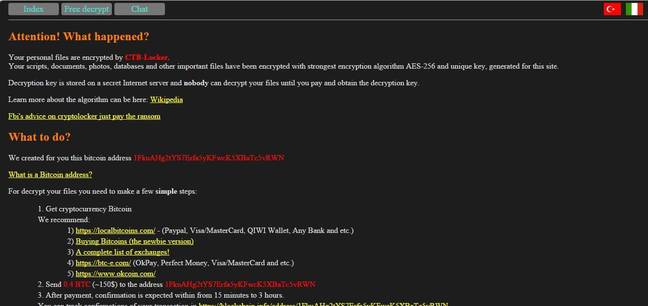
A CTB Locker message left on a currently infected site.
A random scattering of sites and businesses have been affected. One Milton Keynes, UK company which manufactures machinery for the healthcare and tobacco industries has been hit. Wokned has uploaded the ransomware source code to Kernelmode for other researchers to study.
Ransomware is regular flayed by white hat malware researchers who hunt for cryptographic implementation flaws that allow decryption to occur without need of the key.
Those attacks are typically baked into point-and-click tools and dsitributed to users for free.
BitDefender destroyed one hopeless ransomware team's encryption dreams after it found and exploited design flaws in three variations of the Linux.Encoder ransomware.
That led a sarcastic security industry to proffer cryptography tips to the tragically determined black hats. ®
Sponsored: The 2016 Cyber Risk Executive Summary
Source: Reinvented ransomware shifts from pwning PC to wrecking websites
10 Helpful Tips for the New Blogger
This is my second time writing this post because I didn't save it the first time...so my first tip for the new blogger is save early and save often!
February 21 was my official 1 year Blogiversary. I've been celebrating all month by writing a blog series in February. Hopefully 5 Reasons I Blog and Why You Should Too has convinced you that you have a unique story to share with the world. Here are simple step by step instructions for how to start a blog.
There are a lot of mistakes and times when I have felt overwhelmed this past year. Hopefully these 10 helpful tips for the new blogger will save you time and prevent headaches!

*Some of the links below are affiliate links, meaning, at no additional cost to you, I will earn a small commission if you choose to make a purchase. Thank you for your support in this way!
You know the common advice - Don't write down your passwords? They were not bloggers. As you enter the world of blogging, there will be many, many username and passwords. Write them ALL down! Trust me, you won't remember them. Start with writing down your BlueHost* and WordPress Admin usernames and passwords.

Once you've figured out the name (ex: Setting My Intention) and tagline (ex: Simplifying Life One Step at a Time) for your blog, set up your blog social media accounts. You shouldn't try to be active on all social media accounts at once, but you do want to claim the names that go with your blog. The main ones are usually Facebook, Twitter, Pinterest, and Instagram.
I started blogging with a mostly unused marble composition book...then it became two. Now I have notes all. over. the. place! The problem was I was listening to podcasts while walking, or working, and didn't have my notebook with me - so I wrote on post-it notes or a piece of paper. It's out of hand.
I've finally printed out a blogging binder and I'm determined to keep all notes in one spot. I've found I needed a place to jot things down I learn from podcasts, webinars, or books I'm reading; blog post ideas; passwords; and monthly blog statistics. Most blogging binders have those pages and much more.
There are some really nice free blogging printables. I have a board on Pinterest specifically for free blogging printables here. You can print them out and put them in a binder so everything will be in one place. Tanya at Mom's Small Victories has a lovely free electronic blogging binder for those of you who want to go paperless.
I was first encouraged to do this by Kat Lee's podcast - How They Blog. It was helpful to think through who I was writing for. Are you writing for moms? professionals? DIYers? singles? students? What is their life like? What problems do they have in their life? What will they gain by reading your blog? Your content will be more focused if you know who you're writing for.
This is stressed over and over again for beginning bloggers and for good reason. Don't worry about the numbers of people who are visiting or how many comments you have. Just write great posts that help people in some way. You may help someone by giving them tools to start meal planning, by making them laugh, or simply by making them feel less alone.
I've heard people say they try to have 5-10 posts written before "going live" with their blog. I jumped in and hit publish after my first blog post. However, I didn't let family and friends know about my blog until several months had passed.
6. MAKE AN ABOUT PAGEThis is the place where you can let readers know a little more detail about yourself and your blog. Just the act of writing this page will help you to think through what the purpose is behind your blog. Throw in some fun facts about yourself and let your personality shine!
Figure out ahead of time how frequently you can commit to new posts and let people know in your About Page. Don't start out saying you'll be posting 5 days a week and only post once a week. Start out with a conservative number and change it later if you find you're able to post more frequently.
On Setting My Intention, you won't see many photos of my family or their names and that's an intentional choice. I've chosen to blog, but they haven't. One of my sons is adamant about NOT being shown on the blog. I respect that. Figure out what feels right for you.
There are a lot of groups for bloggers. They are a great resource, but they can also be overwhelming and distracting! There are groups for asking questions and there are groups for sharing each other's content.
I've found The SITS Girls, Inspired Bloggers Network, or Learn to Blog great resources for when you have questions for more experienced bloggers. Each of these groups has free resources that are SO helpful. It's also a great way to make connections with other bloggers. Start with only one though! You'll get overwhelmed if you join more than one when you're just beginning.
You can get a unique code here that needs to be installed on your blog. WordPress for Beginners has a tutorial to do that here. I happened to use a plugin which did it for me, because I did not want to mess with code.
Eventually if you want to monetize, you will need Google Analytics (GA) to know your numbers and figure out how much to charge based on traffic to your blog.
After a year of blogging, these are 10 tips for the beginner blogger. I'm constantly learning new things everyday - and that's what makes blogging fun!
If you're a blogger, what advice would you pass on from your first year?
Angela is a wife, mom, and works part time outside of the home. Not a minimalist by nurture or nature, but seeking to simplify life one step at a time. She blogs at http://settingmyintention.com
Source: 10 Helpful Tips for the New Blogger
WordPress sites get Google AMP boost
WordPress has announced that it is to support Google's newly-launched Accelerated Mobile Pages (AMP) initiative which makes mobile pages load faster.
AMP is described as an 'open-source project that borrows some ideas from Facebook's Instant Articles and brings them to the open web'. An AMP-enabled page loads four times faster than a standard site, making it particularly useful to mobile users in areas with poor data speeds.
Automattic, the company behind WordPress.com, said today that it's enabling AMP by default for all WordPress blogs. That means that hosted WordPress users will get super-fast page loads when visitors come to their sites from Google results. Users don't need to change anything or do anything differently.
WordPress has made a plugin available for self-hosted users that automatically converts content as well.
Google search results will now include a small lightning bolt next to AMP sites, indicating that they'll load faster.
Source: WordPress sites get Google AMP boost
10 Helpful Tips for the New Blogger
This is my second time writing this post because I didn't save it the first time...so my first tip for the new blogger is save early and save often!
February 21 was my official 1 year Blogiversary. I've been celebrating all month by writing a blog series in February. Hopefully 5 Reasons I Blog and Why You Should Too has convinced you that you have a unique story to share with the world. Here are simple step by step instructions for how to start a blog.
There are a lot of mistakes and times when I have felt overwhelmed this past year. Hopefully these 10 helpful tips for the new blogger will save you time and prevent headaches!
*Some of the links below are affiliate links, meaning, at no additional cost to you, I will earn a small commission if you choose to make a purchase. Thank you for your support in this way!
You know the common advice - Don't write down your passwords? They were not bloggers. As you enter the world of blogging, there will be many, many username and passwords. Write them ALL down! Trust me, you won't remember them. Start with writing down your BlueHost* and WordPress Admin usernames and passwords.
Once you've figured out the name (ex: Setting My Intention) and tagline (ex: Simplifying Life One Step at a Time) for your blog, set up your blog social media accounts. You shouldn't try to be active on all social media accounts at once, but you do want to claim the names that go with your blog. The main ones are usually Facebook, Twitter, Pinterest, and Instagram.
I started blogging with a mostly unused marble composition book...then it became two. Now I have notes all. over. the. place! The problem was I was listening to podcasts while walking, or working, and didn't have my notebook with me - so I wrote on post-it notes or a piece of paper. It's out of hand.
I've finally printed out a blogging binder and I'm determined to keep all notes in one spot. I've found I needed a place to jot things down I learn from podcasts, webinars, or books I'm reading; blog post ideas; passwords; and monthly blog statistics. Most blogging binders have those pages and much more.
There are some really nice free blogging printables. I have a board on Pinterest specifically for free blogging printables here. You can print them out and put them in a binder so everything will be in one place. Tanya at Mom's Small Victories has a lovely free electronic blogging binder for those of you who want to go paperless.
I was first encouraged to do this by Kat Lee's podcast - How They Blog. It was helpful to think through who I was writing for. Are you writing for moms? professionals? DIYers? singles? students? What is their life like? What problems do they have in their life? What will they gain by reading your blog? Your content will be more focused if you know who you're writing for.
This is stressed over and over again for beginning bloggers and for good reason. Don't worry about the numbers of people who are visiting or how many comments you have. Just write great posts that help people in some way. You may help someone by giving them tools to start meal planning, by making them laugh, or simply by making them feel less alone.
I've heard people say they try to have 5-10 posts written before "going live" with their blog. I jumped in and hit publish after my first blog post. However, I didn't let family and friends know about my blog until several months had passed.
6. MAKE AN ABOUT PAGEThis is the place where you can let readers know a little more detail about yourself and your blog. Just the act of writing this page will help you to think through what the purpose is behind your blog. Throw in some fun facts about yourself and let your personality shine!
Figure out ahead of time how frequently you can commit to new posts and let people know in your About Page. Don't start out saying you'll be posting 5 days a week and only post once a week. Start out with a conservative number and change it later if you find you're able to post more frequently.
On Setting My Intention, you won't see many photos of my family or their names and that's an intentional choice. I've chosen to blog, but they haven't. One of my sons is adamant about NOT being shown on the blog. I respect that. Figure out what feels right for you.
There are a lot of groups for bloggers. They are a great resource, but they can also be overwhelming and distracting! There are groups for asking questions and there are groups for sharing each other's content.
I've found The SITS Girls, Inspired Bloggers Network, or Learn to Blog great resources for when you have questions for more experienced bloggers. Each of these groups has free resources that are SO helpful. It's also a great way to make connections with other bloggers. Start with only one though! You'll get overwhelmed if you join more than one when you're just beginning.
You can get a unique code here that needs to be installed on your blog. WordPress for Beginners has a tutorial to do that here. I happened to use a plugin which did it for me, because I did not want to mess with code.
Eventually if you want to monetize, you will need Google Analytics (GA) to know your numbers and figure out how much to charge based on traffic to your blog.
After a year of blogging, these are 10 tips for the beginner blogger. I'm constantly learning new things everyday - and that's what makes blogging fun!
If you're a blogger, what advice would you pass on from your first year?
Angela is a wife, mom, and works part time outside of the home. Not a minimalist by nurture or nature, but seeking to simplify life one step at a time. She blogs at http://settingmyintention.com
Source: 10 Helpful Tips for the New Blogger
10 Must Have SEO Plugins for every WordPress Blog


If you are a serious blogger, then you might be knowing the importance of SEO for your Blog. SEO Makes your Blog visible in Search Engines. SEO is the one that is responsible for your exposure and traffic. SEO is not an easy task to do. It's not a 2 min work.
Although if you are on wordpress platform, you can handle SEO Easily with the help of Plugins. This is also one of the reason that why WordPress Platform is most preffered. There are plenty of SEO Plugins available for your blog. Just install them in your blog and improve your Rankings. I have created the list of Best SEO Plugins, all these are must have plugins, find all plugins below.
1. All In One SEO Pack
Automatically optimizes your WordPress blog for Search Engines (Search Engine Optimization). It has features of Support for Custom Post Types and Advanced Canonical URLs.
2. SEO Slugs
The SEO Slugs WordPress plugin removes common words like 'a', 'the', 'in' from post slugs to improve search engine optimization. The slug is generated on saving a post (so you get a chance to look at it before publishing, and change it), or on publish.
3. SEO Friendly Images
SEO Friendly Images is a WordPress SEO plugin which automatically updates all images with proper ALT and TITLE attributes for SEO purposes. If your images do not have ALT and TITLE already set, SEO Friendly Images will add them according the options you set.
4. Headspace2
Controls almost every aspect of your site's meta-data, including advanced tagging, Analytics, and dozens of plugins. Its the best SEO Solution.
5. Insights
Insights brings a powerful new way to write your blog posts. It increases productivity and at the same time quality of your posts.
6. XML Sitemaps
This plugin will generate a special XML sitemap which will help search engines like Google, Bing, Yahoo and Ask.com to better index your blog. With such a sitemap, it's much easier for the crawlers to see the complete structure of your site and retrieve it more efficiently.
7. Simple Tags
Add some tools for taxonomies : Terms suggestion, Mass Edit Terms, Auto link Terms, Ajax Autocompletion, Click Terms, Auto terms, Advanced manage term.
8. Scribe SEO
Scribe is an SEO software service for WordPress – think of it as a content optimization assistant – that analyzes web pages, blog posts, and online press releases at the click of a button.
9. Platinum SEO Plugin
Platinum SEO Plugin offers Complete onsite SEO solution for your WordPress blog.Platinum SEO Plugin offers all the functionalities of All In One SEO plugin.
10. SEO Smart Links
SEO Smart Links can automatically link keywords and phrases in your posts and comments with corresponding posts, pages, categories and tags on your blog.
10 Must Have SEO Plugins for every WordPress Blog reviewed by Michael Fisker on February 17, 2016 rated 4.6 of 5
Source: 10 Must Have SEO Plugins for every WordPress Blog
4 Blogging Mistakes Every Newbie Should Avoid
If you're new to blogging, making few mistakes is inevitable. Even the best bloggers have made silly mistakes in the past. Most of them became blogging experts by learning on the go, while some of them learnt their best strategies through trial and error, and they often admit it openly.
However, there are some costly mistakes which could leave an indelible mark on your blogging career or even ruin it. Here are 4 mistakes you should avoid by all means.
If you're serious about blogging, you can definitely make money from it. If not for any other reason, you'll want the money to renew your hosting account in order to keep your blog running. To do this, monetizing your blog is the best bet. But you have to go about this the right way.
You need to build good reputation and gain the confidence of your audience before you start applying your monetizing strategies. Without this in place, readers might just walk away, thinking you want to rip them off.
I've read many bloggers confess that they used to be copy-paste bloggers who would copy interesting articles from different websites and put them on their own blog without permission.
By indulging in this, you could get sued for plagiarism or get penalized by search engines. But ultimately, you're really hurting your reputation. It would be disappointing to your readers when they discover that you stole all those juicy blog posts from other hard working bloggers.
No, you can't cut-and-paste another person's words onto your blog without permission.
Making your blog vulnerable to attacks is one of the most costly mistakes you can make as a blogger. This could lead to hackers taking over your blog completely or exposing it to dangerous malwares or spam content. This would definitely be a nightmare especially if you've invested a lot of time and money in it.
Studies show that people who use the WordPress CMS are more prone to this attack simply because it accounts for more than 25% of websites worldwide. But how do you protect your WordPress blog from attack? There are many precautions to take but the simplest, yet often neglected, ones are to use strong passwords, update your plugins and themes on time, scan your website regularly and create a backup for your site content.
The danger of not renewing your hosting account and domain name on time is that you risk losing them after the term expires. The domain name could be offered for sale if you don't reclaim it early enough, thus making you lose the brand name and identity you've worked hard to build.
To avoid this, use the automatic renewal option. But if you prefer to do it manually, you should ensure that you set reminders, and keep your email with your hosting and domain providers updated so you don't miss any renewal notice. This way, you'll have enough time to make provisions for the renewal.
As you make progress in your blogging career, you'll get to learn other things that would make you smarter than when you first started.
Source: 4 Blogging Mistakes Every Newbie Should Avoid
WordPress now supports Google’s AMP, enabling its sites to load faster on mobile
WordPress has announced that it now supports Accelerated Mobile Pages, Google's ambitious project that wants to make the web load faster on mobile. Introduced in October 2015, the project, AMP, uses an open source HTML code framework to enable sites to load faster on mobile, an idea that is similar to Facebook's Instant Articles.
The Automattic owned WordPress.com is one of the first companies to support AMP. In a blog post, the company said users will now start to see their sites loading faster on mobile. WordPress users will not have to set up AMP, it will be automatic. On the other hand, users that self host WordPress.com site can add a plugin that adds support for the Accelerated Mobile Pages (AMP) Project.
Read more: Google introduces Accelerated Mobile Pages for rich, faster content on mobile
A day ago, Google announced that AMP is now available on mobile search and that the company will now highlight AMP-enabled pages in its mobile search results. It is not clear if Google will prioritise these AMP enabled pages on mobile search. When Google launched AMP, it partnered with nearly 30 publishers such as Mashable, Atlantic Media, BBC, and The Economist to name a few.
AMP-enabled page loads four times faster, allowing mobile users in places with weak signals to still enjoy a mobile experience that is fast.
Nuzzel already supports AMP enabled articles but not many apps do but that is understandable as AMP is still a new thing. With time more apps will be optimised to support it.
Considering that WordPress commands 25 percent of the web, it is important that it is one of the first to support AMP, not only for its own benefit but to legitimise the Accelerated Mobile Pages project.
 Myolisi Sikupela reads and writes about technology. He is the video, photo and podcast guy here at Memeburn. More
 Source: WordPress now supports Google's AMP, enabling its sites to load faster on mobile
WordPress Sites Now Support Google’s AMP To Make Mobile Pages Load Much Faster

Google has some big plans when it comes to making the web faster on your mobile phone. The company just added AMP-enabled pages in its mobile search results. And one of the first companies supporting the new Instant Article-like format is an important one — Automattic, the company behind WordPress.com.
AMP (also known as Accelerated Mobile Page) is an open-source project that borrows some ideas from Facebook's Instant Articles and brings them to the open web. An AMP-enabled page loads four times faster, and it could be useful when you are in the middle of nowhere with a bad cell reception.
The WordPress team has followed the project and worked on its own implementation of AMP. Starting today, any website on WordPress.com now automatically supports AMP. There's nothing to do. Self-hosted WordPress websites can also enable AMP by installing a plugin.
And finally, WordPress.com VIP customers, such as Quartz, FiveThirtyEight, Fortune and TechCrunch can enable support for AMP. This last part is key as AMP is mostly targeted toward news articles for now. Whenever you search for a news story on Google, there is now a carousel of AMP-enabled stories (it's going to be important to see whether non-AMP stories get retrograded following this change). Nuzzel's app also serves AMP-enabled pages when it can. TechCrunch will soon support AMP.
So how does it look? If you're on an AMP-powered WordPress site, you can add "/amp/" at the end of the URL and get the optimized version. Here's an example on Longreads' blog. It's a stripped-down version of the normal post.
And you don't lose much as AMP markup supports a wide range of features. For instance, AMP has worked with ad networks, such as Outbrain, AOL, OpenX, DoubleClick and AdSense, to create optimized tags for mobile pages. So you can still put ad tags in your AMP-enabled pages. Similarly, you can add analytics tools. But these JavaScript calls will be optimized.
For self-hosted WordPress sites, there are various hooks in the code to customize your AMP template. The company is still working on an easier customizing interface for WordPress.com sites.
As for all the things that usually slow down web pages today, such as embeds, JavaScript-heavy content or Flash, WordPress strips out this content from the AMP pages. Comments are also omitted by default.
WordPress adding AMP support is a big deal as 25 percent of the web runs on WordPress. The AMP project is off to a good start with WordPress's backing. All WordPress sites are now potentially AMP-enabled.

Source: WordPress Sites Now Support Google's AMP To Make Mobile Pages Load Much Faster
The Definitive Guide to WordPress Custom Post Types
Gone are the days when WordPress was referred to as just blogging software.
The ability to extend its functionality via plugins and themes, group posts or structured data into various types and also the arrival of the WP Rest API into core, has seen it further evolve into a full blown content management system and development platform.
Over the years, I have successfully developed a number of custom web applications built on-top WordPress that heavily utilize custom post types. An example of one of these web applications is the theme marketplace of my WordPress plugin called ProfilePress.
On a closer look at the theme marketplace linked above, you will discover that it uses a custom pagination system evident in the URL of the Next / Prev pagination links. Thus, it is possible for you to build an in-house pagination system that will work perfectly in querying a custom post type (CPT).
Enough said, let's get down to the purpose of this tutorial which is, learning the intricacies of custom post types in WordPress.
I hope to address the many hurdles I have personally encountered working with CPTs as well as some cool stuff you can do with it.
Custom Post Type DefinitionWordPress can hold and display many different types of content. A single item of such content is generally called a post, although a post is also a specific post type.
Internally, all the post types are stored in the same place, in the wp_posts database table, but are differentiated by a column called post_type.
Post type refers to the various structured data grouped together that is maintained in the WordPress database posts table.
Examples of post types are post (a group of blog posts), page (a group of pages), attachment (a group of uploaded media files), and revision (a groups of post revisions) that are native or built-in to WordPress.
Armed with the definition of post type, a new post type that is created and registered to WordPress is referred to as a custom post type.
If you're building a company or business website with WordPress, examples of post types you could create are Portfolio, Testimonials and Products.
Now that we've understood the concept of custom post types, up next is learning how to create them.
Creating Custom Post TypesCreating a custom post type is pretty easy. Firstly, register the post type with the register_post_type() function and finally, wrap register_post_type() in a function call and hook it to the init Action like so:
function portfolio_cpt() { $args = array( 'label' => 'Portfolio', 'public' => true, ); register_post_type( 'portfolio', $args ); } add_action( 'init', 'portfolio_cpt' );From the code above, you can see register_post_type() has a second function parameter that accepts a number of array arguments necessary in customizing every aspect of a custom post type.
You should now see the Portfolio custom post type appear in WordPress admin dashboard.

It's worth noting that when calling register_post_type(), the second argument is optional. That is, a CPT can be also created as follows:
function portfolio_cpt() { register_post_type( 'portfolio' ); } add_action( 'init', 'portfolio_cpt' );If a CPT is created in this manner, it won't show up in the admin dashboard menu (albeit still accessible via direct URL access "http://example.com/wp-admin/edit.php?post_type=portfolio") and its UI wordings (otherwise referred to as labels) and admin notices will be the same as the built-in post post type.
Let's go over some of the array arguments for customising CPTs and their respective functions.
LabelA plural descriptive name for your custom post type. For example, if you are creating a movie CPT, this should be Movies.
It will default to the value of $post_type which is the first parameter of register_post_type().
LabelsAn array of labels for this post type. Each string is a bit of text displayed in a particular admin page.
Be sure to make these strings translatable if you're creating a plugin for public use.
A full list of labels and their descriptions can be found here.
descriptionA short descriptive summary of what the post type is, although I haven't found where this is used in WordPress admin.
publicDepending on its Boolean value, it'll automatically decide what other arguments should be unless they're specifically defined. If you're looking to have more control over the public arguments, there are three specific arguments you may set:
By default, a new post type is added after the 'Comments' menu item in the admin. But you have to ability to move it to a suitable position of your choosing.
For example, setting the menu_position value to 70 will add your menu item below Users.
New post types will default to the Posts menu icon, but if you want a custom icon in it instead, set this label to the URL of the icon or image file.
'menu_icon' => get_stylesheet_directory_uri() . '/images/portfolio-icon.png',You can also use any dashicon as your CPT icon.
Say you want to use the download dashicon, set this label to the dashicon value as follows:
'menu_icon' => 'dashicons-download', hierarchicalThis argument allows you to decide whether to make your CPT hierarchical or not. The default value is false. Set to true to make your CPT hierarchical.
supportsThe supports argument allows you to define an array of meta boxes and fields that will appear on the screen when editing or creating a new post. This defaults to title and editor.
Setting this argument to false will prevent the default (title and editor) behavior.
There are several available options:
Provides a callback function that will be called when setting up the meta boxes for the edit form. The callback function takes one argument $post, which contains the WP_Post object for the currently edited post.
This feature is particularly useful to developers for them to create custom meta boxes that will show up in the CPT edit screen.
'register_meta_box_cb' => 'metabox_callback_func', taxonomiesAn array of registered taxonomies like category or post_tag that will be used with this custom post type.
'taxonomies' => array( 'post_tag', 'category '), has_archiveSetting this argument to true will enable archives for your custom post type. For example, say your CPT is books, visiting http://yoursite.com/books will display a list of posts belonging to books custom post type.
rewriteThis argument allows you to define the permalink structure of your custom post type when viewing a single post or archive.
Default value is true and uses $post_type as slug. To prevent rewrites, set to false.
Let's see some examples for clarity sake.
Say you created a review custom post type but wish to change the URL slug from review to assessment, using the following rewrite argument will change the URL from http://example.com/review/harry-potter/ to http://example.com/assessment/harry-potter/ for single posts and http://example.com/review/ to http://example.com/assessment/ for the CPT archive.
'rewrite' => array( 'slug' => 'assessment', 'with_front' => false ),Whenever you do a rewrite of WordPress URL, ensure you click the Save Changes button in Settings >> Permalinks to recreate the rewrite rules.
So basically, the slug defines the new URL slug while with_front determines if the permalink structure be pre-pended with the front base.
Still not clear on with_front? Let's see an example.
Say you have a permalink structure with blog appended to the URL as depicted in the image below.

If with_front is set to false, the URL of a single post and post archive becomes http://example.com/blog/assessment/harry-potter/ and http://example.com/blog/assessment/ respectively but if it is set to true, the URL of a single post and post archive respectively becomes http://example.com/assessment/harry-potter/ and http://example.com/assessment/.
Notice the omission of blog in the latter? That's the difference.
can_exportUse this argument to decide whether posts belonging to your custom post type can be exportable via the WordPress export tool. By default, this is set to true.
query_varThis argument allows you to control the query variable used to get posts of this type.
If set to true, it will allow you to request a book custom posts type via example.com/?book=harry-potter where harry-potter that is the URL slug of a book entry or post.
If set to a string rather than true (for example publication), you can do: example.com/?publication=harry-potter.
Caveat of "query_var"If query_var is undefined in your CPT registration array argument, it defaults to $post_type thus, it is always defined unless you set it to false.
Here comes the caveat. Whenever the value of a query_var is added as a query string to a URL, it will lead to a 404.
Let me clarify. Say the value of your CPT query_var is review and a query string with the key set to review was added to any URL of your WordPress site in any of the following forms:
This will cause a 404 to happen.
I actually learned about this the hard way. As at the time I had this issue, I created a ticket in WordPress core trac to report it as a bug.
It took me weeks to finally figure it out before some members of the core WordPress team replied my ticket.
Speeding up Custom Post Types Setup with PluginsNow that we've covered the foundations, it's a good time to point out that there are a number of plugins in WordPress plugin repository that makes creating custom post types very easy.
Examples include (but are not limited to):
ConclusionIn this tutorial, we learned what custom post types are and how they're created.
This is actually the first in a series on WordPress custom post types. In my next tutorial, we will learn how to customize the various admin notices, how to register custom taxonomies to a post type and adding contextual help tab to your CPT screen.
Until then, happy coding!
Source: The Definitive Guide to WordPress Custom Post Types
Joomla targeted in WordPress campaign that delivers TeslaCrypt

Former NSA Director filed a motion asking a federal court to quash a lawsuit that named him personally violating Americans' constitutional rights as a result of the NSA's bulk metadata ...

A new survey of U.S. payment service providers revealed that approximately 37 percent of retailers were ready to process EMV payments by Feb. 1, 2016.

The Acecard Android banking trojan leaves nothing to chance when it comes to attacking banks with the malware being able to attack 50 separate online financial applications and bypass Google ...
Source: Joomla targeted in WordPress campaign that delivers TeslaCrypt
Hackers leverage 26,000 WordPress websites in massive DDoS attack
Hackers are abusing the 'pingback' function used in many WordPress websites to launch DDoS attacks against their victims.
In a blog post, IT security firm Suruci said that rather than hackers using DDoS to throw the websites offline by bombarding them with a huge number of packets, this type of attack was more precise, taking advantage of the pingback feature that generates a comment on a blog when someone else with pingback enabled links to it.
"Layer 7 attacks (also known as HTTP flood attacks) are a type [of] DDoS attack that disrupts your server by exhausting its resources at the application layer, instead of the network layer," said Daniel Cid, CTO at Sucuri.
"They do not require as many requests or as much bandwidth to cause damage; they are able to force a large consumption of memory and CPU on most PHP applications, CMSs and databases."
The firm said that hackers were using the technique in a new campaign that used a botnet comprising 26,000 WordPress websites. While it did not identify the victims, the company admitted this type of DDoS attack comprised 13 per cent of all DDoS against its clients.
Cid explained these websites were being used to generate a sustained rate of 10,000 to 11,000 HTTPS requests per second against one website.
"At some intervals, the attack would peak to almost 20,000 HTTPS requests per second. The attack started at 1pm (EST) and by midnight it was still ongoing," he said.
"Very few servers would be able to handle such a load, even with proxies and load balancers configured. Especially when talking about HTTPS requests which tend to use more CPU to establish the SSL session."
Such attacks accounted for around 13 per cent of all DDoS attacks the firm tracked for clients, according to Cid.
He added that while WordPress now logged the attacker IP address on newer releases, he was still recommending that WordPress websites disable pingbacks.
"It won't protect you from being attacked, but will stop your site from attacking others," he said.
Source: Hackers leverage 26,000 WordPress websites in massive DDoS attack
To trust or not to trust: Small business survey hails WordPress, dings Yelp


Please Sign In and use this article's on page print button to print this article.
Yelp's CFO to depart, according to leaked earnings report
Yelp and OpenTable end partnership
Great Value and Opportunity
For small business owners, WordPress is a well-trusted company, Yelp is a brand in trouble, and Facebook is on a downward path. Those are some of the findings out today from a survey of 6,000 small business owners from the second half of 2015 conducted by Alignable, a two-year-old social network for local entrepreneurs.
]]>Alignable, which is headquartered in Boston and has members across the country, started doing its SMB Trust Index at the beginning of last year but this is the first time the company has released its findings to the public. To do its analysis, Alignable relied on the Net Promoter Score approach companies use to gauge their own customer loyalty.
"As you build trust, your net promoter score goes up," Alignable co-founder and CEO Eric Groves told the Business Journals. Groves went through the 25 national brands that made up the list, all representing companies, products and services that small business owners use. In keeping with the Net Promoter approach, each one was ranked on a scale of 0-10 with the companies then getting final scores with a maximum score of 100 for the most trust to negative 100 for the least trusted.
Check out the full ranking in the infographic below. Here are some of the results that Groves highlighted:
Most trusted: WordPress— The website creation tool had a NPS of 73 and the report determined that "WordPress proves 'free' doesn't always mean 'junk.'" Groves said he was surprised by how trusted WordPress was, which he attributed to its passionate following. "I knew it was a great platform, but I didn't know that their following was that ravenous."
Least trusted: Yelp— The San Francisco-based website that allows users to rate and review small businesses was itself poorly ranked. It had an NPS of -66. "The problem is, the majority of small business owners feel like they're held captive to a certain extent by Yelp," Groves said, noting that restaurants tend to view Yelp more favorably than other businesses. "What this score says is that there are lot more people with a negative trust factor of Yelp than a positive factor."
Falling: Facebook— Even though the Alignable survey is still relatively new, one company that's seeing a progressive downward trend is the world's largest social network, which has an NPS of 24. Groves attributed the drop to a change Facebook did at the start of 2015 that caused posts by small businesses to drop from their customer's feeds unless the businesses paid to promote them. "They flipped from being an engagement platform to a media outlet and they did it without really helping small businesses understand why they were making a transition, and they really didn't take them along for a ride in a very nice way," Groves said.
For more details about the report, see the results below and check out Alignable.
J. "Josh" Jennings Moss has spent time on the police beat in Florida, on the political trail in Washington, D.C., and on the business front in New York. Among the places he's journalized: Condé Nast Portfolio, FoxNews.com, ABCNews.com, the Advocate, the Washington Times, and the Tampa Tribune. Josh graduated from the University of Arizona and lives in New York City.
Yelp's CFO to depart, according to leaked earnings report
Yelp and OpenTable end partnership
Great Value and Opportunity
Source: To trust or not to trust: Small business survey hails WordPress, dings Yelp
More bad WordPress, campaign switches from Nuclear EK to Angler EK

John McAfee said his teams of hackers could crack the iPhone used by the San Bernardino shooters within three weeks.

The Department of Defense (DoD) has commenced an enterprise-wide deployment of Microsoft's Windows 10 operating system as part of an effort to bolster IT security and standardize processes, Microsoft announced ...

Squid patched a vulnerability that allowed remote attackers to launch a denial of service attack when connected to TLS or SSL servers.
Source: More bad WordPress, campaign switches from Nuclear EK to Angler EK
Some WordPress Basics For Newbies
WordPress is a content management system (CMS) that is built using PHP and MySQL. A typical CMS, like WordPress, helps the user eliminate the need to develop HTML pages and upload them individually to the server. It is an interface mainly used to build a blog, but it can also be used to establish other websites. It helps the admin manage the posts, comments and images that are uploaded to the site. So, making a website is now a cakewalk.


Each and every WordPress site comes with a default theme. These themes have files that form the design functionality of the entire website. These themes will be available in the folder /wp-content/themes. Themes are made of a variety of files like Template Files, Stylesheet Files, Javascript files, Image files and Other files. Here, the most important type of files is the Template Files, which are .php files. Stylesheet files will have .css files that will decide how the content will look on the website(padding, fonts, background color, etc.). Javascript Files will have javascript functions declared in classes that have some logic behind them to display data or manipulate it. Image files will have images in .jpeg or .jpg. The Other Files could be text files or Powerpoint presentations.
How does WordPress determine which pages to load?
WordPress follows something called a 'template hierarchy'. This means all the template files fall in either of these categories:
● Primary Template
● Secondary Template
● Variable Template
● Page Type
The Primary template occupies the highest level and Page type, the lowest level. WordPress follows the web template system and uses a template processor for the same. When finding the file to load, WordPress' template processor follows the bottom-up approach.
Let's take an example. Say the URL:
'www.domainname.com/blog/category/chocolatecake' reaches the web server.
Over here, the index.php is our Primary Template file and categorychocolatecake.php is our Variable Template file. So, the processor backtracks until the lowest level data are available.
Advantages of WordPress:Easy to use: Due to the simple and user-friendly interface provided by WordPress the usage of this tool is so much easier when compared to other CMSs.
Easy to extend: The functionality of various themes, plugins and widgets could be extended to perform as the user requires. This means, customizability is not only available at the top level but also at the root level.
Massive Community: WordPress community is big and always ready to help. So, support is never an issue.
It's free!: Using WordPress, you can customize your website by choosing from the thousands of free themes and plugins or just release your website using the basic default theme provided by WordPress. However, either of them won't cost you anything (unless of course you plan to opt for the premium themes or plugins).
WordPress and other CMS:Among a lot of other content management systems available in the market Joomla, Drupal and WordPress occupy the top 3 choices for a user. Although each of these could be used interchangeably for any website you want to build, they are apt for certain "types" of sites. WordPress is used by people that are new to making websites and are new to technology on the whole. It gives away a lot of usability for the user and is best for a medium scaled website including blogs.Joomla is slightly complicated, in that, it requires some level of technicality to be applied. However, a lot of e-commerce websites opt for Joomla.Drupal is very complex in nature but at the same time very efficient. A lot of coding is required on the backend, but excellent performance is guaranteed.Depending upon the need and skill, one can choose from a vast pool of CMSs.
Security in WordPress:Your WordPress website being hacked is probably not even the last thing on your list. You always want to ensure to maintain security for your users and your content. Although WordPress has timely releases happening for its security and maintenance, the primary requirement will be to keep your blog/website updated with the latest WordPress versions. This was, the updates will happen automatically. Secondly, all your table prefixed should be renamed from wp_ to anything that is customized. Along with that, it is advisable to avoid the common usernames and passwords like admin, webmaster, WordPress user, etc. These type of security fixes are called "Security by obscuring." Also, taking data backups, monitoring your logs and your files are good ways to keep a check on the activities happening on your website. Additionally, you can also use plugins like All in One WP Security and Firewall, WP Security Scan, WPDB Manager, etc.
Customization in WordPress:Almost everything on WordPress is customizable. Be it your themes, plugins, widgets, anything! That is the beauty of WordPress. You can create a child theme that will inherit properties from the parent theme, making your theme unique to your website. Along with that, you can edit the style.css file in your particular theme's folder that will change the CSS of your website. That means same theme, just different colors and schemes. You can also modify the functionality of plugins by adding your code to something called "hooks" so that your plugins can do much more now. However, plugins slow down your website and make it thick. So, the addition of custom code is also a good practice.
WordPress is for all, well, at least, most!Like I mentioned before that CMSs are wonderful as they could be used interchangeably to build almost any website. A lot of companies like BBC America, Sony Music, MTV News, Best Buy, etc. are using WordPress. So it's not only for blogs but also for other websites that have constant updates running. It is however not ideal for an e-commerce website as it does not provide the right kind of architecture for it.
Source: Some WordPress Basics For Newbies
Perspectives on Going Viral
Feb 17, 2016 @ 3:00 pm

Please do not use these comments for asking questions, support, or bug reporting. Use the forums or support contact form for that.
Please read our comment guidelines before posting.
Source: Perspectives on Going Viral
Have you fixed your WordPress site yet?
Antivirus is not catching it yet making this a very dangerous situation. Word Press sites have been repeatedly hacked throughout 2014 and 2015. Looks like 2016 will be no different. So far, no one has figured out exactly how the sites are getting compromised.
Researchers from Malwarebytes and other security firms have reported that a massive number of legit WordPress sites are silently redirecting visitors to sites with the Nuclear Exploit Kit. "WordPress sites are injected with huge blurbs of rogue code that perform a silent redirection to domains appearing to be hosting ads," Malwarebytes Senior Security Researcher Jérôme Segura wrote in a recent Malwarebytes blog post. "This is a distraction (and fraud) as the ad is stuffed with more code that sends visitors to the Nuclear Exploit Kit."The compromised WordPress sites included encrypted code at the end of all legitimate JavaScript files. The attack tries to conceal itself and the code redirects end-users through a series of sites before dropping the ransomware payload. Once a WP server is infected, the malware also installs a variety of backdoors.
The malware tries to infect all accessible .js files.
What to do if you are running WordPress:
Protecting a network and your users:
 Stu Sjouwerman (pronounced "shower-man") is the founder and CEO of KnowBe4, LLC, which provides web-based Security Awareness Training (employee security education and behavior management) to small and medium-sized enterprises. A data security expert with more than 30 years in the IT industry, Sjouwerman was the co-founder of Inc. 500 company Sunbelt Software, an award-winning anti-malware software company that he and his partner sold to GFI Software in 2010. Realizing that the human element of security was being seriously neglected, Sjouwerman decided to help entrepreneurs tackle cybercrime tactics through advanced security awareness training. KnowBe4 services hundreds of customers in a variety of industries, including highly-regulated fields such as healthcare, finance and insurance and is experiencing explosive growth with a surge of 427% in 2 013 alone. Sjouwerman is the author of four books, with his latest being Cyberheist: The Biggest Financial Threat Facing American Businesses.Related Keywords:Wordpress Malware
Source:Digital Media Online. All Rights Reserved
Source: Have you fixed your WordPress site yet?
free Responsive WordPress magazine,news & blog theme
 Log In Popular Best way to get a black eye?Community Need a simple popup (modal, on-page-load with time-delay, fast & clean)JavaScript Forum Posting BasicsGet Started Inline styles for a:link, a:hover etc in an email newsletterHTML & CSS Trying to implement spl_autoload_register()PHP Changing and loading an iframe 'src' attribute with jQueryJavaScript Insert an image into index.php filePHP Load url with javascriptJavaScript What does this mean: RewriteCond %{REQUEST_FILENAME} !-f/d?Server Config How to add CSS to HTML codeHTML & CSS More… Recent Domains that are the same (before the dot)Domains Autoload For Function in PHPPHP Does PR, DA, PA matter for SEO when they are relevant?Marketing This Week in JavaScript - 15 February 2016JavaScript DomDocumentPHP Create a PDF of a signed formPHP Terms-of-ServiceDesign & UX Sort data of addresses into TableGeneral Web Dev Javascript for MySQLJavaScript Choose A Busines Name with SEO In Mind?Marketing More… Search this site Google
 Source: free Responsive WordPress magazine,news & blog theme
Embattled copyright lawyer uses DMCA to remove article about himself
Website dedicated to finding Asha Degree
Wendy Hughes is a mother who just wants to help another mother.
Hughes, of Charlotte, launched the online blog,www.findingashadegree.wordpress.com, which began garnering public attention at the beginning of January. She wants nothing more than to help the Degree's find Asha.
"What I want to accomplish is, I want the Six Degrees of Separation theory to come to fruition. I want that person who knows someone, who knows someone, to see the blog and talk themselves into coming forward," Hughes said. "It could be that simple to end 16 years of questions, and good or bad, bring Asha home."
The 55-year-old has no ties to the Degree family but still felt like she needed to do something.
"I felt I had a connection to Asha's mom. I felt her pain — just a smidgen, though — we both had similar circumstances in the same year (2000)," she said. "My son went missing when he was about (Asha's) age. He was only gone 45 minutes, but it could have ended up much different."
Hughes also runs a Facebook page called Finding Asha Degree: Shelby's Sweetheart, where she posts updates on research that she believes could be tied to Asha's disappearance.
The blog lists, in detail, Hughes' opinion on what happened the February morning when Asha disappeared. Hughes first started it as a way to satisfy her curiosity about the incident, but as she dug deeper and deeper into the case, her blog expanded along with her curiosity.
"In my earliest days researching and poking around the web, I was amazed at how many people know and talk about Asha on social media, from crime sleuth forums, Reddit, even mommy-type forums," she said. "People love her, and their heart goes out to the Degree family.
"But there would be tidbits about Asha's case here and then misinformation there. It was then that I decided to dig deep for the correct information - as correct as I could manage - and post it to my blog."
Iquilla Degree, Asha's mother, was upset upon learning about the the blog several weeks ago.
"I was headed to work one day and my brother called me, it was a Sunday evening, and started telling me about (this website)," Degree said.
She, and others in the family, were concerned about what type of information was being posted to the blog, but the family decided to look into it a bit more.
"We figured it was something with (Natioanl Center for Missing and Exploited Children) or the FBI," Degree said.
Degree has looked at the blog and described much of it as "half-truths." She said she has no knowledge of ever meeting or speaking to Hughes about the site, but she is taking it with a grain of salt.
Page 2 of 2 - "Somebody knows something. And if it keeps her story out there…" Degree trailed off, with a shake of her head.
Degree may not be a fan of the blog, but law enforcement doesn't think it's necessarily a negative.
"People wanting to help doesn't burden the case whatsoever," Cleveland County Sheriff Alan Norman said. "I had a person recently say that they drive a truck, and any time that they see a young person in another truck, they check to see if it matches the description of Asha."
Outsiders doing their own research don't have access to the same information as law enforcement, but the work they do on their own is not always a hindrance, according to Dr. Laura Pettler, vice president of the American Investigative Society of Cold Cases.
"I've seen it go both ways. Families (and people) have helped gather information while maintaining a respectful and good relationship with law enforcement agencies," Pettler said. "I have also seen it go very, very poorly. It really depends on both parties (citizen and law enforcement officers). First and foremost, the integrity of the case must be maintained."
Norman said he encourages people to be as informed as possible about the case, and if they discover anything they think could be relevant, to contact the department.
"Law enforcement officers are only good as the information that they receive from the public," he said. "Any input can be good."
Source: Website dedicated to finding Asha Degree
No desktop required: WordPress for iOS now lets you create new sites
WordPress, the most popular blogging platform on the Web, continues to update its official iOS app with new features to make on-the-go WordPress blog and website management quicker and easier.
In recent months, improvements delivered to WordPress for iOS included support for more site settings, notification filters, and iPad split-screen multitasking.
Now, the app has been updated with another round of improvements, which include a couple of significant new features for on-the-go WordPress bloggers and website owners.
On-the-go site creationWordPress for iOS has long been enabling users to carry out a number of key blog and site management tasks. These include creating and editing posts and pages, moderating comments, viewing site statistics, uploading media, and more.
Now, you can add site creation to that list.
Indeed, you can now create a new WordPress.com site right within the app — no desktop required.
To create a new WordPress.com site in the app, just go to My Sites, tap the plus button, tap "Create WordPress.com site," enter a title and a subdomain name, and tap "Create Site." And just like that, your new WordPress.com site is created right from the app.

The latest update to WordPress for iOS also lets you access themes right at your fingertips.
In the details screen of your blog, there's a new Themes option that you can select to access the Themes Browser in the app. You can search and filter themes, tap the ellipsis button for a theme to preview and customize it, and then activate it. Again: No desktop required.

As expected, the latest update to WordPress for iOS includes bug fixes and other under-the-hood improvements.
WordPress for iOS is available on the App Store for free. It's compatible with iPhone, iPod touch, and iPad running iOS 9.0 or later, and with WordPress.com blogs and self-hosted WordPress.org sites running version 3.6 or higher.
Related Articles
It's official: Instagram for iOS now supports multiple account switching
You may already be able to switch between multiple accounts on Instagram
Source: No desktop required: WordPress for iOS now lets you create new sites